Friday Stuff
No Theme Whatsoever Edition
Reminder: As my way of saying thank you for helping me reach 1,000 subscribers, for the rest of June, if you upgrade to a paid annual subscription it’s half-off the usual price for the first year. Usually that’s $60, but we’ll make that $30 if you sign up between now and June 30. Here’s the link to do that:
Thanks again everyone!
Monday
This was the date in 1946 when Bill Veeck bought the Cleveland Indians.
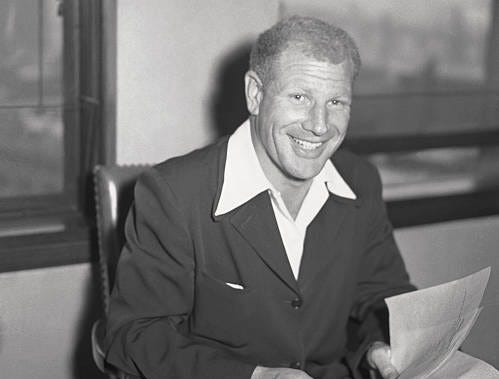
The son of longtime Cubs executive Bill Veeck, Sr., Veeck had also worked for the Cubs for many years, starting as a popcorn vendor and working his way into the front office after his father’s passing. He was the team treasurer at one point, and was also the guy who thought up the idea of planting ivy along the outfield walls at Wrigley Field.
Not satisfied with working for other people, Veeck pulled together an investment group and bought the minor league Milwaukee Brewers in 1940. The team stunk, and Veeck set out to turn them around. Despite taking time off to serve in the Marine Corps during World War II, during which time he lost his right leg when it was crushed by an artillery piece, Veeck guided the Brewers to a massive improvement that saw them win three straight regular season pennants. In the middle of that stretch, Veeck made a bid to buy the Philadelphia Phillies. His bid was rejected, despite Veeck’s claims that he offered more than the ultimate sale price, allegedly because Veeck had made it known that he intended to stock the club with star players from the Negro Leagues.
Always operating with limited funds, Veeck sold the Brewers after the 1945 season for a profit of nearly $300,000, and it was that money that he used as the base for another investment group that bought the Indians the next year. They, too, had gone through a string of mostly losing seasons at the time he bought them, and this time he followed through on his plans to integrate the team but signing Larry Doby and later Satchel Paige. The team moved above .500 in his first full season as owner in 1947, and won the World Series a year later with Doby and Paige playing critical roles.
Alas, the constant money troubles that would plague his entire career in baseball forced Veeck to sell the team in 1949, this time to finance a divorce settlement with his first wife. Two years later, remarried and refunded, he bought the St. Louis Browns. As with the Indians and Brewers before them, the Browns were terrible when Veeck bought them. Pretty much the only way he could afford to buy teams was if they were depreciated assets due to terrible play or ownership problems. Unfortunately, there was no magical turnaround for the Browns, though Veeck tried his best to attract crowds through a variety of oddball promotions like sending little person Eddie Gaedel to bat or having the fans vote on in-game decisions by the manager. He also raised the idea that American League teams pool and share their radio and television revenue to create a more level playing field, a notion that was rejected by his peers but has since been adopted by pretty much every sports league except Major League Baseball.
Veeck had to sell the Browns after the 1953 season and was out of baseball for a time, but jumped back into it in 1959 by purchasing the Chicago White Sox. They immediately won the American League pennant for the first time in 40 years and broke the franchise attendance record, just as the Indians had done when Veeck was there. Veeck directed a renovation of Comiskey Field, including the installation of the famous “exploding” scoreboard that would launch fireworks every time a White Sox player hit a home run.
Health issues forced Veeck to sell in 1961, and once he felt better he tried a few times to buy other teams before finally succeeding in repurchasing the White Sox in 1975. In those interim years he testified on Curt Flood’s behalf during his suit against Major League Baseball, invoking the wrath of commissioner Bowie Kuhn and his fellow owners, and he further angered them when he proposed a gradual transition to a free agency system based on service time. That proposal was rejected, and the owners then had to scramble in 1976 to come up with a compromise with the Players Association after an arbitrator implemented free agency against their wills.
Ironically, the dawn of higher payrolls that were spawned by the same expansion of players’ rights Veeck had supported also forced him out of baseball for the final time. As always, he’d been operating the White Sox on a shoestring budget, and that became impossible as salaries rose past his capacity to pay them. He sold the team in 1981, leaving baseball without his color, his ideals, and his innovation.
I think baseball is a better game because Bill Veeck was part of it, and I think it would be better now if someone like Bill Veeck was still involved.