
Friday Stuff
#1 Overall Draft Pick Edition
Programming note: All posts this week are unlocked and free to everyone, as my way of saying thank you for helping me reach 1,000 subscribers. It’s fun writing for you, and the fact that we’re growing encourages me to write more, so this is my way of saying thank you for that.
Also, if you’re liking what you read here, I’ll make you a deal as further thanks. For the rest of June, if you upgrade to a paid annual subscription it’s half-off the usual price for the first year. Usually that’s $60, but we’ll make that $30 if you sign up between now and June 30. Here’s the link to do that:
Thanks again everyone!
Monday
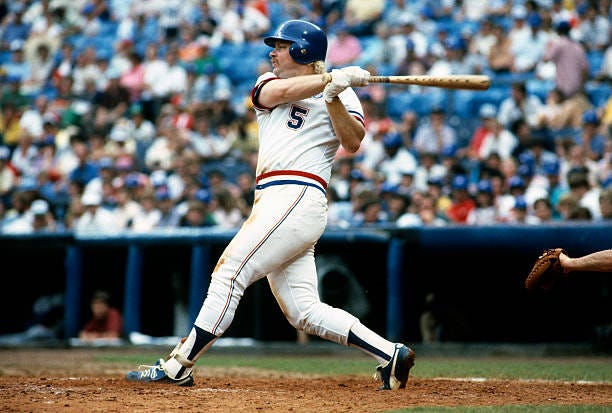
This was the date in 1978 when the Braves used the first overall pick in the draft to select Bob Horner, who sadly passed away a couple of weeks ago at the ago of 68.
If you’re around my age, Horner was sort of a folk hero during your teenage years. Without spending a single day in the minor leagues, he stepped right into the Braves’ lineup in the middle of that season, blasted 23 homers in only 89 games, and walked away with the Rookie of the Year Award. Then he followed that up with 33 homers the next year, and 35 the next, and 32 in the next non-strike season in 1982.
Horner didn’t have a lot of other skills on the field. He couldn’t run at all, was a mediocre-to-poor defender who was limited to third base, and didn’t draw many walks. Horner also had a terrible time staying healthy. He played as many as 140 games in a season just twice, and even then he barely got there; 140 games in 1982, and 141 in 1986.
He stood in stark contrast to teammate Dale Murphy, the tall, multi-skilled, durable center fielder who was endlessly approachable for both fans and media. It was sort of an Odd Couple situation, with Horner playing the role of perpetual slob Oscar Madison, a paunchy, grouchy contrast to Murphy’s All-American image.
But no one watching cared. Horner arrived in Atlanta just as Braves games were being made available across the country on Ted Turner’s newfangled Superstation. This was decades before you can watch out-of-market games whenever you wanted. In fact, it was years before most teams even aired every game locally. Owners were terrified that putting their games on television would kill ticket sales, and they were really unhappy that some other team from across the country was now infringing upon their territories.
The reason they were scared is because people were watching those Braves games. Largely that was simply because they were on and no other games were, but what made that team fun to watch during those years was the dual presence of Murphy and Horner in the middle of their lineup absolutely abusing their incredible home field advantage.
Much had been written about ballparks that have been remarkably favorable to hitters over the years. The old Baker Bowl in Philadelphia, Fenway Park before the press box expansion killed the wind the blew balls over the Green Monster, Coors Field before the humidor, and so on. Sometimes lost in all of that is the clunkily-named Atlanta-Fulton County Stadium, a.k.a. “The Launching Pad.”
Home of the Braves for their first 30 years in Atlanta, it was a haven for hitters during its existence. Braves players had some of the most extreme home/road splits in baseball. For instance, here’s how the entire team fared at home versus on the road for a few years starting in 1978, the year Horner arrived:
1978: .264/.340/.414 (Home); .224/.289/.312 (Road)
1979: .268/.332/.399 (Home); .245/.305/.354 (Road)
1980: .264/.320/.405 (Home); .237/.294/.356 (Road)
You get the idea. On the road, the Braves were an atrocious offense, considerably below league average in every respect, but back home in Atlanta that were not only competent but actually pretty good. If they got to play every game there they’d have fielded one of the top offenses in the National League every year. Murphy was a good example of this. He spent all or part of 15 of his 18 big league seasons with the Braves, and ended with a home OPS that was 103 points higher than his road OPS.
But no one benefitted more from The Launching Pad than Bob Horner.
One the road, Horner was still an above average hitter, but certainly not a star. He had a career road batting line of .260/.321/.428. He was essentially Wilmer Flores or Josh Reddick as a road player. There’s nothing wrong with that, but it’s far from a superstar.
But, at home in Atlanta, Bob Horner was Albert Belle.
Belle (career): .295/.369/.564
Horner (Home): .295/.359/.570
Say what you want about Albert Belle off the field, but you’ve got to admit that he was remarkably fun to watch when he stepped to the plate. That was Bob Horner for those of us lucky enough to watch his home games back in the late ‘70s and early ‘80s when there were few baseball options available.
Horner made those games fun to watch instead of just being the only baseball on TV, so I’ll always have a warm spot for him in my memory banks.
Tuesday
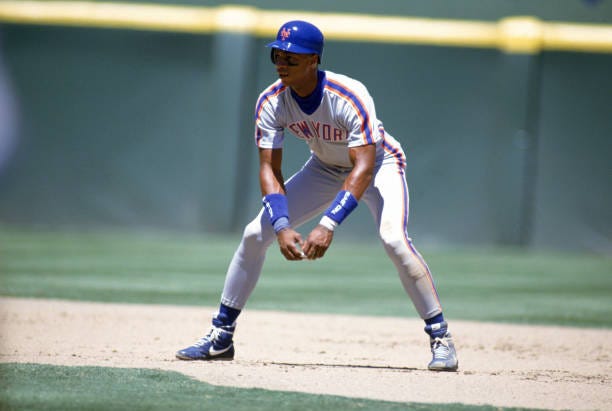
It was on this date in 1989 that the number one overall pick in the 1980 major league draft, Darryl Strawberry, hit the 200th home run of his big league career.
At that point, he was in very rare company. Only 27 years old, Strawberry was a former Rookie of the Year, was playing his sixth consecutive All-Star season, and was the defending runner-up in voting for the National League MVP Award. He was also the defending league home run champ, and had led the league in slugging, OPS, and OPS+ as well. He’d fallen just one steal shy of his second straight 30-30 season, and was in the midst of his first really excellent defensive season in right field, too. He’d ultimately end the year leading all right fielders in range and fielding runs, and probably deserved a Gold Glove. The most similar player to him at that age was Reggie Jackson, and there’s a good argument to be made that Strawberry was the more complete player of the two.
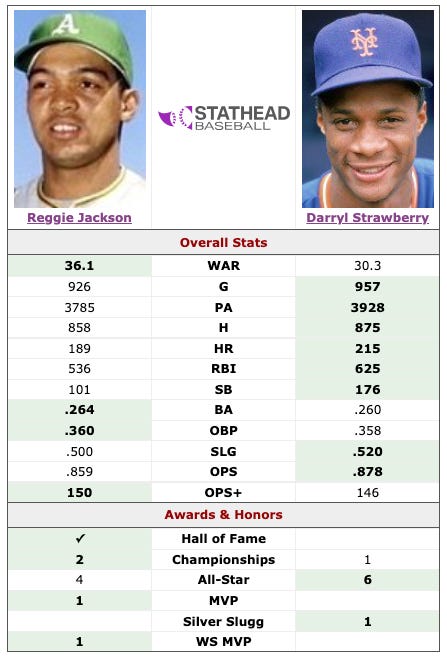
Strawberry had more homers through the age of 27 than not only Jackson, but also Babe Ruth, Eddie Murray, Manny Ramírez, Duke Snider, Lou Gehrig, Frank Thomas, Mark McGwire, and Ernie Banks. He had more than Barry Bonds, Hank Greenberg, Mike Schmidt, and Willie McCovey. He was clearly on his way to the Hall of Fame.
That level of performance continued for another couple of years, earning him a huge free agent contract (for that time) with his hometown Dodgers before the 1991 season and proving he was worth it by promptly hitting 28 homers, driving in 99 runs, making his eighth straight All-Star team and again finishing in the top-ten in MVP voting.
But then it all came to a screeching halt.
Not his career. That dragged on for eight more seasons, not one of which was spent as a regular in any team’s lineup. He not only never made another All-Star team, but never even got 400 plate appearances in a season, and only once surpassed 100 games played. Partly it was injuries, and partly it was attitude, things like oversleeping or failing to show up for a game, or arguing with teammates.
What it really was was a horrible drug and alcohol addiction, and those led to a string of health and legal problems. He got divorced, and missed child support payments, and was convicted of tax evasion, and was sued by his lawyers for failing to pay his legal fees. Then came a bought with colon cancer that eventually spread to his lymph nodes and one kidney, and an arrest for soliciting sex from an undercover cop, resulting in a suspension from Major League Baseball. He was a mess, and another suspension for cocaine use after the 1999 season ended his career.
Despite all of that, when Strawberry actually got onto the field during these lost years of his life, the guy could still hit. From 1992 to 1999 he still had an OPS of .802, and OPS+ of 111, and averaged 26 homers and 81 RBI per 162 games. He did all of that while drunk, or high, or undergoing chemo, or being chased for his legal issues. Or all of the above.
One can only imagine what he might have done during the last half of his career if he’d been able to control his addictions. Darryl Strawberry may not be the greatest “what-if” ever, but he’s probably in the class photo.
Wednesday
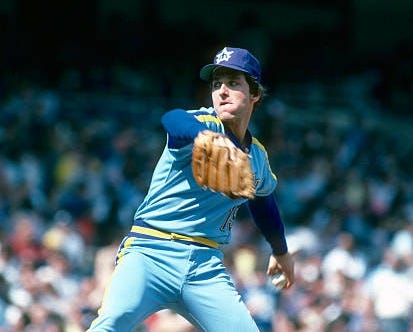
Wednesday marked the date Floyd Bannister was born in 1955. The number one overall pick in the 1976 draft by the Houston Astros, Bannister was the defending College Player of the Year according to The Sporting News, a lefty with a good fastball and even better curve. Though he ultimately had a pretty good major league career, Bannister was also one of the unluckiest pitchers of his time.
That started with the fact that the Astros felt they were only one more pitcher away from being a pretty good team. They were awful in 1975, but the ‘76 squad took a big leap to third place in their division on the strength of an above-average offense, and they needed someone in the rotation behind J.R. Richard, Joaquín Andújar, and Larry Dierker. Consequently, they drafted Bannister and rushed him to the big leagues the following year after 43 innings in the minors.
Banister held his own that first year considering the circumstances, but the Astros really weren’t as close to being good as they’d expected. They finished just 81-81, and were 74-88 the year after that. Bannister was part of that problem as he had a poor second year, so the team decided to ship him to the Mariners in exchange of shortstop Craig Reynolds.
Unfortunately for Bannister, the Mariners were in just the third season in franchise history and still weren’t very good. He spent four seasons there and the team was a combined 103 games below .500 in that time, and it would have been more if not for the 1981 strike that washed out a third of the season. Considering the paltry support he had a round him, Bannister was pretty good. He was 10-15 with a 109 ERA+ in 1979 while his teammates gave him nearly half a run less in run support than they gave the rest of the rotation. A year later he was 9-13 despite a 119 ERA+ and only 3.38 runs per game of support. He managed a break-even record of .500 in 1981 despite the team finishing 21 games below .500, and in 1982 he made the All-Star team for the only time in his career when he was 12-13 on a team that was ten games below .500, had a 124 ERA+, and led the league in strikeouts.
Seeing that things weren’t about to get better in Seattle, Bannister wisely left as a free agent after that season, joining the White Sox just as they were finally returning to the postseason for the first time in nearly a quarter of a century. Bannister was a big part of that, as he went 16-10 with a 3.35 ERA and 125 ERA+ while leading the league in strikeout rate. Even then he was somewhat unlucky, as the White Sox averaged nearly five runs per game that season but about a quarter of a run less than that when Bannister pitched.
Then things went bad pretty quickly. Bannister struggled for the next couple of years and so did the White Sox. He righted himself in 1986 when he posted a 3.54 ERA and 123 ERA+, but the team barely gave him any runs to work with, averaging just 3.32 runs in his starts and over four when he didn’t. They fired manager Tony LaRussa mid-year, but that didn’t do much to turn the team’s fortunes around. In 1987 Bannister was their best pitcher with a 16-11 record and 3.58 ERA even though the team again scored less with him on the mound than they did for the rest of the staff.
After that year he was traded again, this time to the Royals just as they were sliding from the high that had seen them reach the postseason seven times in the prior 12 seasons. That 1988 team had a pretty good pitching staff, and Bannister could slot into the fourth spot in their rotation, but he began to develop some arm issued and went just 12-13. After that he hurt his shoulder for good the following year, missed most of the season, pitched in Japan in 1990, then returned for a couple of middling-to-poor seasons as a reliever for the Angels and Rangers.
Overall, Bannister finished his career with a record of 134-143 despite a career ERA that was a bit above average. If he’d played in more neutral environments for .500 teams who gave him average run support, his record projects to 139-130, a .517 winning percentage that would have been 33 points higher than the .484 mark he actually had.
That’s a perfectly respectable career, but it’s probably not what he or the Astros had in mind when he was the first player taken in the draft.
Thursday
This was the date in 2013 when Gerrit Cole made his major league debut with the Pirates. He was only 22, had been the number one overall pick in the draft almost exactly two year earlier, and if you’d told Pittsburgh fans at the time that the most similar pitcher to Cole a decade later would be Max Scherzer they’d have been thrilled. Scherzer was in the midst of his first Cy Young season in 2013 after leading the league in strikeout rate the year before. Here’s where they both stood after their age-32 seasons:
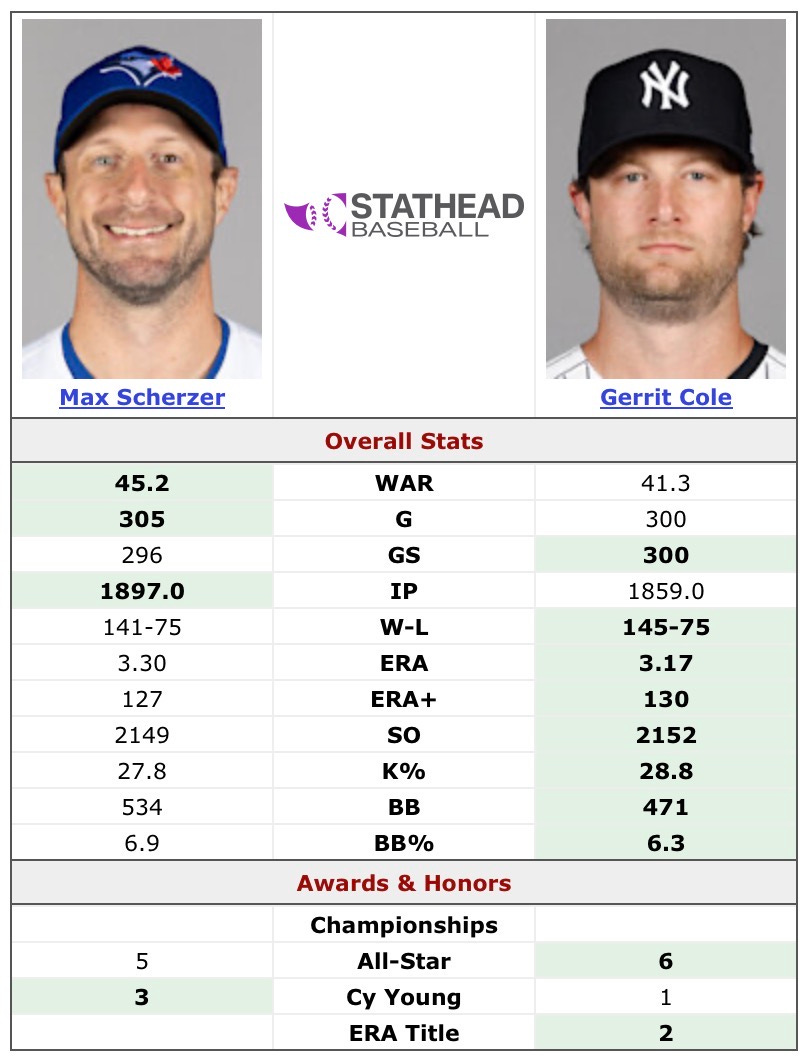
There wasn’t much to separate them. Scherzer had a couple more excellent individual seasons than Cole, resulting in those two other Cy Young Awards, but that was more luck than anything. They had the same number of top-2 Cy Young finishes, three each, it just so happened that all three of Scherzer’s were first place finishes while Cole’s were a first and two seconds. In top-5 finishes Cole actually edged out Scherzer, 6 to 5. The slight difference in their WAR totals goes away when you realize Cole’s totals include the truncated 2020 season and Scherzer’s do not.
So if you’re placing bets after Cole’s age-32 season, 2023, on whether or not he’d make the Hall of Fame one day, the odds would have been that he would. And he still might, but there’s a reason why they don’t vote until your career’s been over for a few years, and Cole is an excellent illustration of why.
Age 33
Scherzer:18-7, 2.53 ERA, 7.9 WAR, second in Cy Young voting
Cole: 8-5, 3.41 ERA, 1.9 WAR, blew out his elbow
Age 34
Scherzer: 11-7, 2.92 ERA, 5.3 WAR, third in Cy Young voting
Cole: Missed the entire year.
Age 35
Scherzer: 5-4, 3.74 ERA, 2.2 WAR in the shortened COVID season.
Cole: Remains to be seen. So far he’s been good in a handful of starts as he’s trying to come back from the elbow issue.
Age 36
Scherzer: 15-4, 2.46 ERA, 6.1 WAR, 3rd in Cy Young voting.
Cole: The Yankees can only dream of that kind of season from Cole next year.
That’s all it takes to go from great odds for the Hall of Fame to sketchy ones. Instead of looking like a great comparison to a first-ballot lock like Scherzer at the age of 32, Cole suddenly looks like a different Cy Young winner, David Price, at the age of 35.
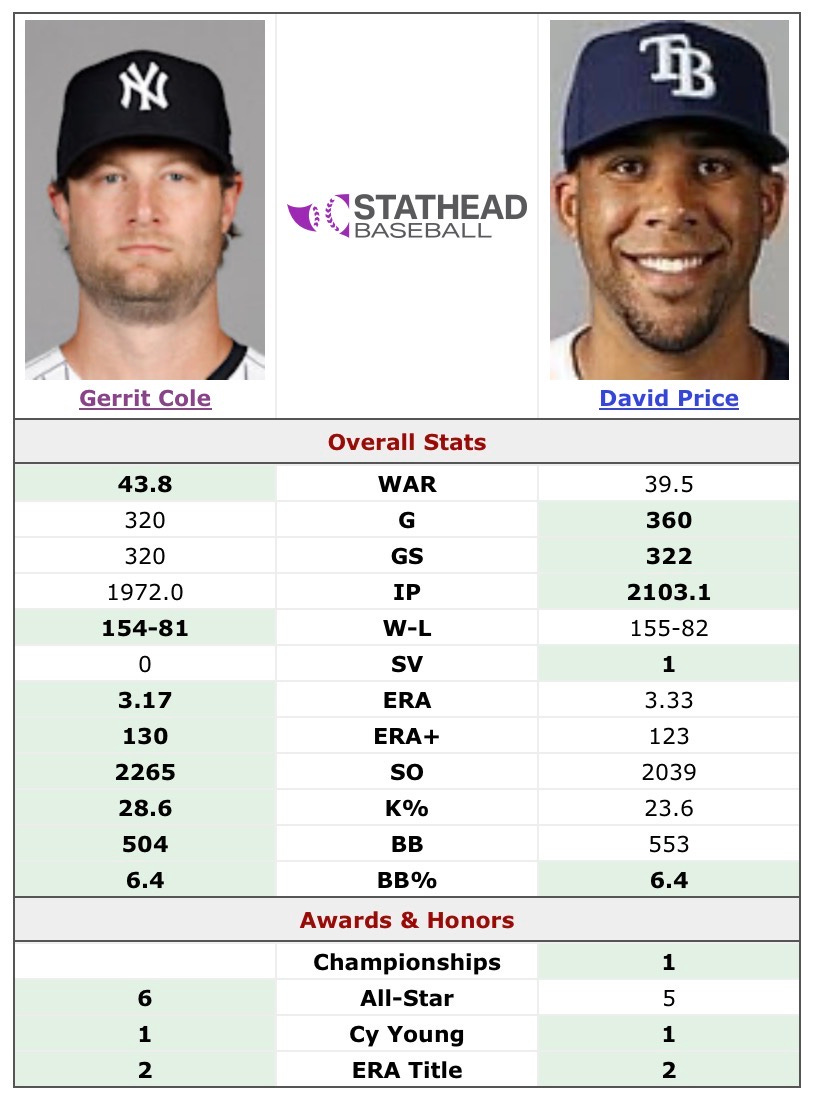
Anyone want to bet on his Cooperstown chances now?
Friday
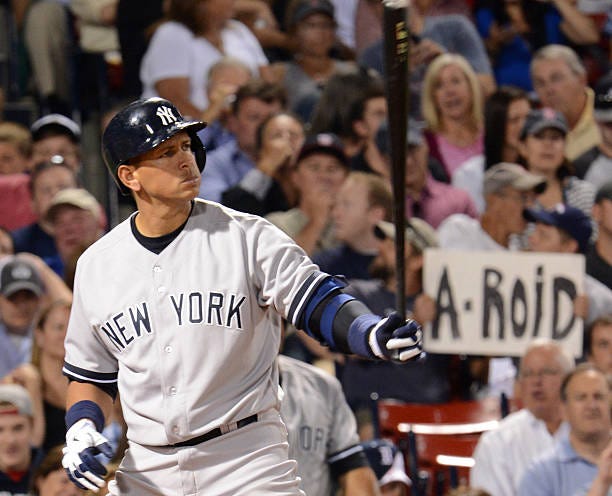
Finally, Álex Rodríguez hit his 23rd career grand slam on this date in 2012, tying Lou Gehrig for the most ever. He’d break the all-time record a year later with a blast off George Kontos of the Giants, then hit his 25th and final grand slam in an August 2015 game against J.R. Graham of the Twins. That remains the most ever.
However…
Gehrig hit his 23 grand slams in only 9,665 career plate appearances. ARod reached that number of career PAs on April 20, 2010, and had only 18 grand slams at the time. He was also only a year removed from his admission of using performance enhancing drugs during the three years he’d spent with the Texas Rangers. Those were the 2001-2003 seasons, during which he hit three of those first 18 grand slams.
Then, in August 2013, Rodríguez was suspended for the rest of that season and all of the following one for using HGH during the 2010 to 2012 seasons. It was during those years that he hit the five additional grand slams that raised him from the 18 he had through 9,665 plate appearances to the 23rd one that tied him with Gehrig. Rodríguez initially appealed that suspension, and that appeal was still pending when he hit grand slam #24 on September 20 against Kontos to break Gehrig’s record.
So, in summary, eight of Rodríguez’s 25 career grand slams were definitely hit during seasons when he was known to be taking PEDs, and a ninth, the actual record-breaker, was hit while playing a game he would have missed if he’d immediately begun serving the PED suspension he’d earned instead of appealing it. An unknown number of the eight grand slams he hit between his first admitted PED use in 2001-2003 and his known HGH seasons of 2010-2012 may also have been hit under the influence of PEDs he simply hadn’t been caught using yet.
In light of all this, and considering June is the month we recognize Lou Gehrig Day, can we go ahead and reinstate him as the all-time Grand Slam record holder? Rob Manfred, are you paying attention? Any interest in pulling a Ford Frick in this case?
This Week’s Editions
Monday: Baseball Remembers: George Foster
Tuesday: Late Bloomers: Al Brazle
Wednesday: First Gloves: Dave Cash
Thursday: The Evolving Genius of Ted Turner
Another great reason to watch Braves games in those days was the marvelous Skip Caray. Gone way too soon and sadly lamented.