Friday Stuff
Putting the WORLD in World Cup Edition
The final of the World Cup will be played in a couple of days, so this week we’re doing something a bit hokey and spelling out World with each entry. Hey, it’s hard to pick themes. Cut me some slack.
Monday - W
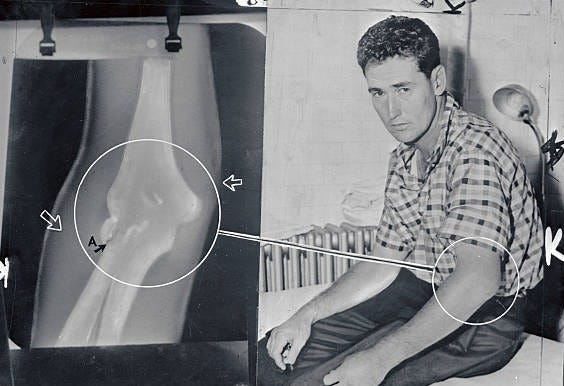
On this date in 1950, Ted Williams had surgery to remove bone fragments from his elbow, which was broken when he crashed into the outfield wall during the All-Star Game a couple days earlier.
That began a major shift in Williams’ availability to the Red Sox for the rest of his career. Not withstanding the three seasons he missed during World War II, until that injury he’d been a very durable player. Here are his games played and missed each season up to that point:
1939: 149 played, 3 missed.
1940: 144 played, 10 missed.
1941: 143 played, 12 missed.
1942: 150 played, 2 missed.
1946: 150 played, 6 missed.
1947: 156 played, 1 missed.
1948: 137 played, 18 missed.
1949: 155 played, 0 missed.
1950 (First half): 70 games played, 7 missed.
That’s a total of 1,254 games played and only 59 missed before that elbow injury, or nearly 96% of Boston’s games. After that, Williams’ availability rarely approached those levels again.
1950 (Second half): 19 played, 61 missed.
1951: 148 played, 6 missed.
1952 (Until Korea service began): 6 played, 6 missed.
1953 (After Korea service ended): 37 played, 9 missed.
1954: 117 played, 39 missed.
1955: 98 played, 56 missed.
1956: 136 played, 19 missed.
1957: 132 played, 22 missed.
1958: 129 played, 26 missed.
1959: 103 played, 51 missed.
1960: 113 played, 41 missed.
That’s not a great record. With the exception of 1951, Williams missed more games in each full season after that elbow injury than he’d missed in any season before it. He missed 336 of 1,374 possible games, playing roughly 76% of Boston’s total. Now, obviously, having Ted Williams available for only three quarters of your games is better than having nearly anyone else available for every single one of them, so the Red Sox were still well ahead of the game by having him in these years.
But Williams’ projected career totals have been calculated many times by folks who want to see what he might have done with the games he missed serving his country. I’ve done that exercise myself. I’ve never seen, though, what he might have done if he’d just been available in the second half of his career as much as he’d been in the first half.
We already know he didn’t have much of a dip in production as he aged. His batting line through 1950 was .353/.488/.642, and after that it was .335/.474/.624, meaning he showed almost no drop in his hitting as he aged. What could he have done if he’d played even 90% of the team’s games during those later seasons? That would have given him almost exactly 200 more games than he actually played. At the rates he actually produced in those seasons, 200 extra games would have results in 208 more hits, 43 doubles, 44 homers, 138 RBI, and 164 walks. That’s would have made him the all-time leader in walks when he retired. He’s have been fourth in RBI and would still be in the all-time top-ten. His 565 homers would have trailed only Babe Ruth.
None of this changes how we think of Williams. He’s a legend and always will be. But while he military service is often the focus of “what might have been” discussions surrounding him, a smaller version of that exists with just his overall availability in the latter half of his career.