
First Gloves: Dave Cash

Programming note: All posts this week are unlocked and free to everyone, as my way of saying thank you for helping me reach 1,000 subscribers. It’s fun writing for you, and the fact that we’re growing encourages me to write more, so this is my way of saying thank you for that.
Also, if you’re liking what you read here, I’ll make you a deal as further thanks. For the rest of June, if you upgrade to a paid annual subscription it’s half-off the usual price for the first year. Usually that’s $60, but we’ll make that $30 if you sign up between now and June 30. Here’s the link to do that:
Thanks again everyone!
When I was a kid, I was convinced that Dave Cash was just about the coolest player in baseball.
I’m not sure why, exactly, because he didn’t play for my team and wasn’t in the same league, either, so I never got to see him play very much. But I always thought he looked cool on his baseball cards, and he had that awesome name, Dave Cash, and smiled a lot, and wore his hat just so. All of that led me to conclude that he just exuded an aura of coolness, and if I’d been lucky enough to have a Dave Cash signature model Wilson glove as a kid, I’d have been pretty proud of it.
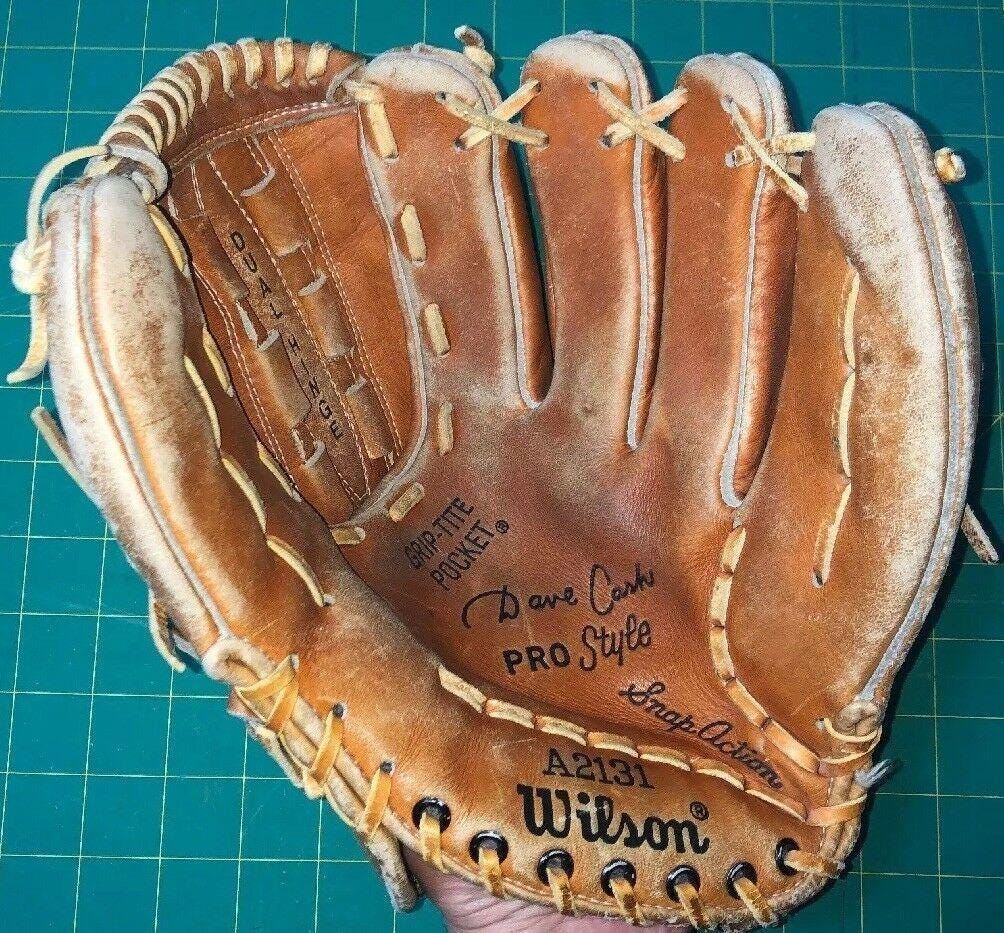
It wasn’t until much later that I learned of Cash’s start with the Pirates, the history he and that team made in the early 1970s, and the central role he played in shifting the balance of power in the National League East across the state of Pennsylvania from Pittsburgh to Philadelphia. He then further contributed to the rise of another NL East team, the Expos, and ended his career as Ozzie Smith’s favorite double play partner in San Diego. It was quite a ride when all was said and done.
And the most consistent part of it, besides his winning attitude, was his glove.
Cash was born in Utica, New York, and ended up spending nearly all of his big league career playing in the cold weather of the northeast. Drafted by the Pirates out of high school in 1966, he joined a burgeoning juggernaut, one that was built largely upon Black ballplayers.
That wasn’t always easy, like when Cash was assigned to Pittsburgh’s rookie team in Salem, Virginia. He and teammate Gene Clines regularly found themselves having to enter restaurants and hotels through the back door to comply with Jim Crow laws, or find alternate places to eat or stay altogether. Even so, Cash quickly established himself as a top prospect, particularly when he batted .335 and led the Western Carolina League in hits in 1967 when he was only 19. By 1969 he was in Triple-A and got called up to the Pirates in September.
The problem Cash faced at that point was twofold. First, as a member of the Army Reserve, he faced several years of interruptions as he was called away to to serve on weekends or during the summer, causing him to miss significant time during the Pirates’ seasons. The other problem was that he was battling not only a deep roster of prospects in Pittsburgh’s system, but one of the team’s legends as well.
Bill Mazeroski remained a fan favorite in Pittsburgh and was still an outstanding defensive second baseman when Cash arrived in the big leagues. Taking his place was always going to be hard, but it was made more difficult by a large group of middle infielders all battling for playing time. That included veteran Gene Alley , who was moved off shortstop in favor of Freddie Patek, and Rennie Stennett, who blew through three minor league seasons with successively better batting averages of .288, .327, and .344, which increased as he rose to face better competition.
It made for a tough set of circumstances for Cash, who found himself on the bench or back in Triple-A for most of 1970 despite batting .314 in the limited playing time he got with the Pirates. In 1971 he took over as the main second baseman, helping the team to their first World Series title since 1960, but both Mazeroski and Stennett still got significant playing time that season, forcing Cash to third base for two dozen games. Moving him to third in one of those games allowed the Pirates to field the first all-Black lineup in major league history on September 1 that year.
Still, the playing time situation got even worse in 1972 and 1973, as his Army Reserve commitment really kicked in and Stennett’s play demanded more time on the field. Cash was limited to less than 500 plate appearances in each of those seasons, and his offense suffered a bit as a result. He had a combined OPS+ of 93 in those two years, down from 103 in his first three big league seasons, but he didn’t let that impact his defense. He’d learned well from Mazeroski, an 8-time Gold Glove winner who had been very generous in helping Cash improve. In 1972 Cash led the league in range and fielding runs but was robbed of a Gold Glove when it went to Félix Millán of the Braves. He again demonstrated above average range in 1973, but missed nearly 50 games due to his Army service and the emergence of Stennett.
The situation clearly needed a resolution, and Pittsburgh decided to handle it by trading cash to the Phillies for Ken Brett on October 18, 1973. It wasn’t a terrible deal for the Pirates because it allowed Stennett to play every day and Brett made the All-Star team for them in 1974, but it turned out to be a fantastic trade for Philadelphia.
For several years the Phillies had been surviving with Denny Doyle as their second baseman and a rotating cast of characters at first base. That right side of the infield contrasted sharply with the defensive brilliance of third baseman Mike Schmidt and shortstop Larry Bowa on the left side, so acquiring Cash went far in stabilizing their infield defense. It also coincided with the end of his Army commitment, allowing Cash to miss only two total games in the next three seasons combined.
His offense blossomed with the regular play. Cash batted .300 and made his first All-Star team in 1974, as he set new career highs with 206 hits, 26 doubles, 11 triples, 58 RBI, and 20 steals. He also played exceptional defense, as usual, leading the league in assists and fielding runs and combining with Bowa to form a league-leading double play combination. Again he lost the Gold Glove, this time to Joe Morgan.
More important than his play on the field was Cash’s leadership in the Phillies’ clubhouse. He brought an upbeat attitude to the ballpark every day, and instilled a sense of confidence that the young team was on the brink of being able to unseat the powerhouse Pirates for the division. They took a huge step toward that in 1975, posting their first winning record in eight years and finishing second to Pittsburgh. Cash stepped up his offense yet again, leading the league with 213 hits and setting new career highs with a .305 batting average, 111 runs scored, and 40 doubles on his way to another All-Star selection.
It was 1976 when the Phillies finally broke through. Cash established the team slogan, “Yes We Can,” in their quest to unseat his former team at the top of the division, and remained an All-Star on the field as well, leading the league in triples and pacing all second basemen in double plays turned for the third straight season while also leading the league in fielding percentage. Philadelphia won the division, the first of four title in five years, and Cash batted .308 in the NLCS against the Reds.
Unfortunately, it couldn’t last. Cash was part of the first-ever free agent class after the 1976 season, as the Phillies had not yet grasped the new economics in baseball. While they limited themselves to signing less expensive players like Richie Hebner and Davey Johnson, Cash was allowed to move on to the Expos for a 5-year, $1.5 million deal.
That worked out well for both Cash and the Expos, as he continued his solid play for the next couple of years and brought veteran leadership to a talented but very young team that had never produced a winning season. New manager Dick Williams installed Cash as the regular second baseman in 1977 and the team’s win total jumped by 20 over the prior year. A year later Cash was again leading all second basemen in putouts and fielding percentage, and in 1979 he batted .321 as the team produced their first winning record and nearly beat Pittsburgh for the division title.
That proved to be Cash’s last good year in the big leagues. With youngster Rodney Scott ready to take over the position, Montreal traded Cash to the Padres before the 1980 season. He remained a solid glove next to the brilliant Ozzie Smith, but his offense crashed to a .227 average and he missed more than 30 games with a nagging knee problem. San Diego released him after the season, and he wasn’t able to latch on with another club, ending his playing career.
Cash moved to Florida with his family and went on to a long career coaching and managing in the minor leagues, with periodic stops in the big leagues, too, before retiring for good in 2011. He remains a fixture at reunions for both the Pirates and Phillies teams of the 1970s, enjoying his distinctive place as the steady glove and strong leader who was a member of the two organizations that accounted for nine of the ten NL East titles in that decade.
That doesn’t make Dave Cash the coolest player of those years, but it makes him cool enough to me.
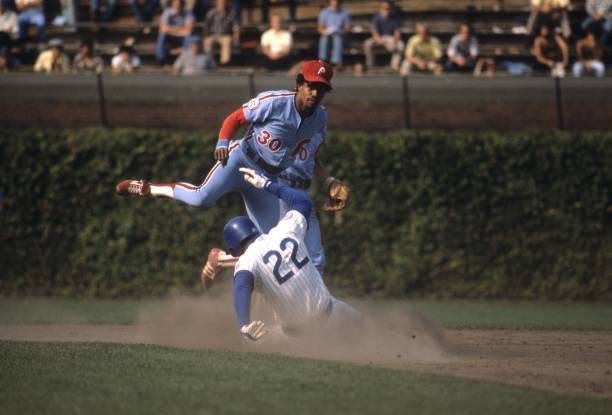
Great column! You and I both thought he was about the coolest player in baseball! I first started watching the Phillies some in 1975 and Dave Cash became my favorite player. By 1976 I was hooked on baseball in general and the Phillies specifically. I was also intrigued by the facial hair on his chin. Cash also gave me my first lesson on free agency. I discovered he was on Montreal in 1977, but was greatly confused that we got nothing back for him. That made no sense! No offense to Ted Sizemore, but he was no Dave Cash. A number of years ago I went to a Reading Phillies and he was managing the opposition, I believe the Bowie BaySox. Cash's departure from Philly made Greg Luzinski my then favorite player, so much so that I have a son named Greg.
Dave Cash is a name I had not heard/read in decades, it’s a strange sensation remembering someone so quickly and clearly just now with instant recall, those .300/200+ hits seasons pinged the radar hard back then for a kid like me, leafing through baseball magazines or yearbooks, or watching the occasional ABC Game Of The Week or whatever it was.
While looking at Cash’s OPS+ now suddenly makes his bat ring strangely hollow, I’m also finding out that he made up the difference with some sterling defense.